

Overview
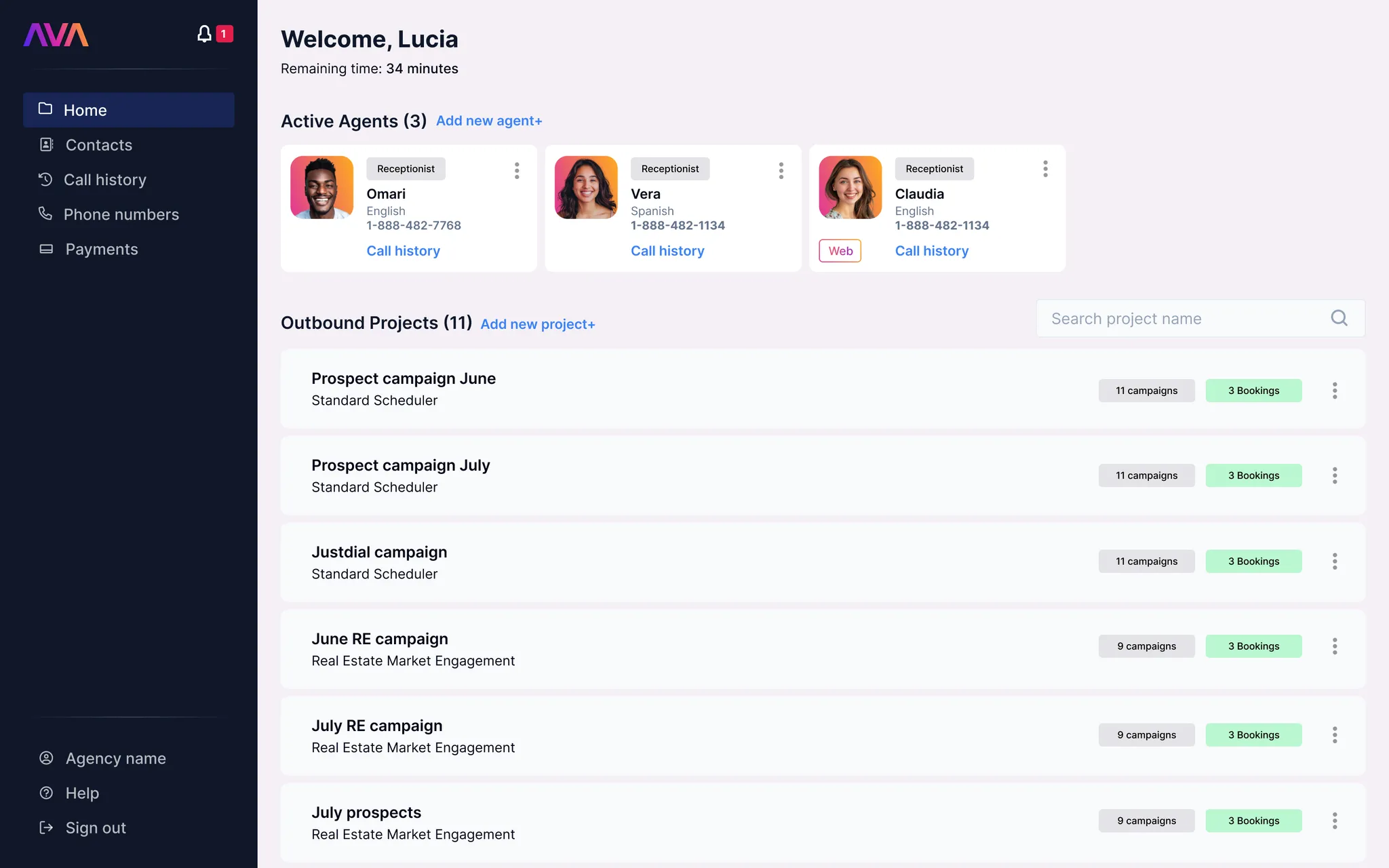
These Agents act as virtual receptionists, customer service representatives, or sales assistants, helping businesses handle inbound calls and website interactions seamlessly.
There are a number of benefits to deploying an AI-powered Inbound Agent for your business including, but not limited to:
- Customizable – Fully configurable for phone and web use.
- 24/7 Availability – Always ready to assist customers, reducing missed opportunities.
- Seamless Call & Web Integration – Deploy AI to answer calls or assist web visitors.
- Custom Branding & Behavior – Train AI with business-specific knowledge.
- Consistent – Train once and never again and expect professional and consistent responses every time, all the time.
- Multiple Language Options – Build a team of inbound agents, each assigned to a specific supported language like French, Spanish, German, Korean, and more.
Details
There are two types of Inbound AI Agents that can be created in the thinkrr.ai Voice AI platform:- Phone-Based Inbound Agents – Handle incoming calls by answering customer inquiries, scheduling appointments, and transferring calls.
- Web Agents – Assist website visitors in real-time by providing information, answering FAQs, and booking appointments.
How to Create an Inbound Agent
Access the Agent Creation Page
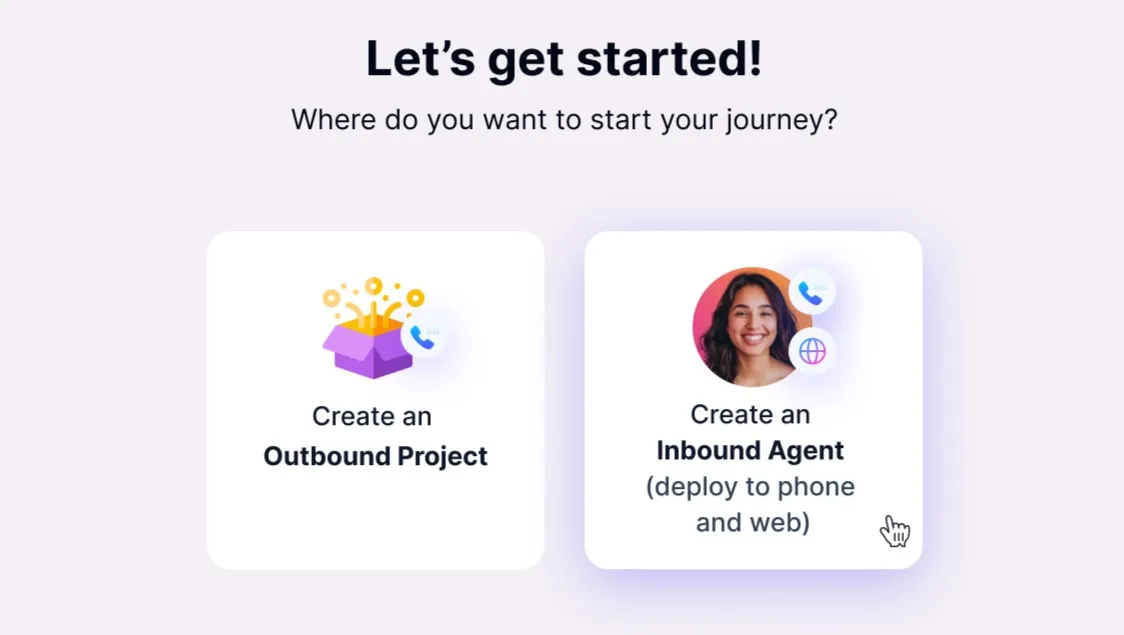
- If it’s your very first time in thinkrr, you will be prompted to create an Outbound Project, or an Inbound Agent. Select “Create an Inbound Agent”.
-
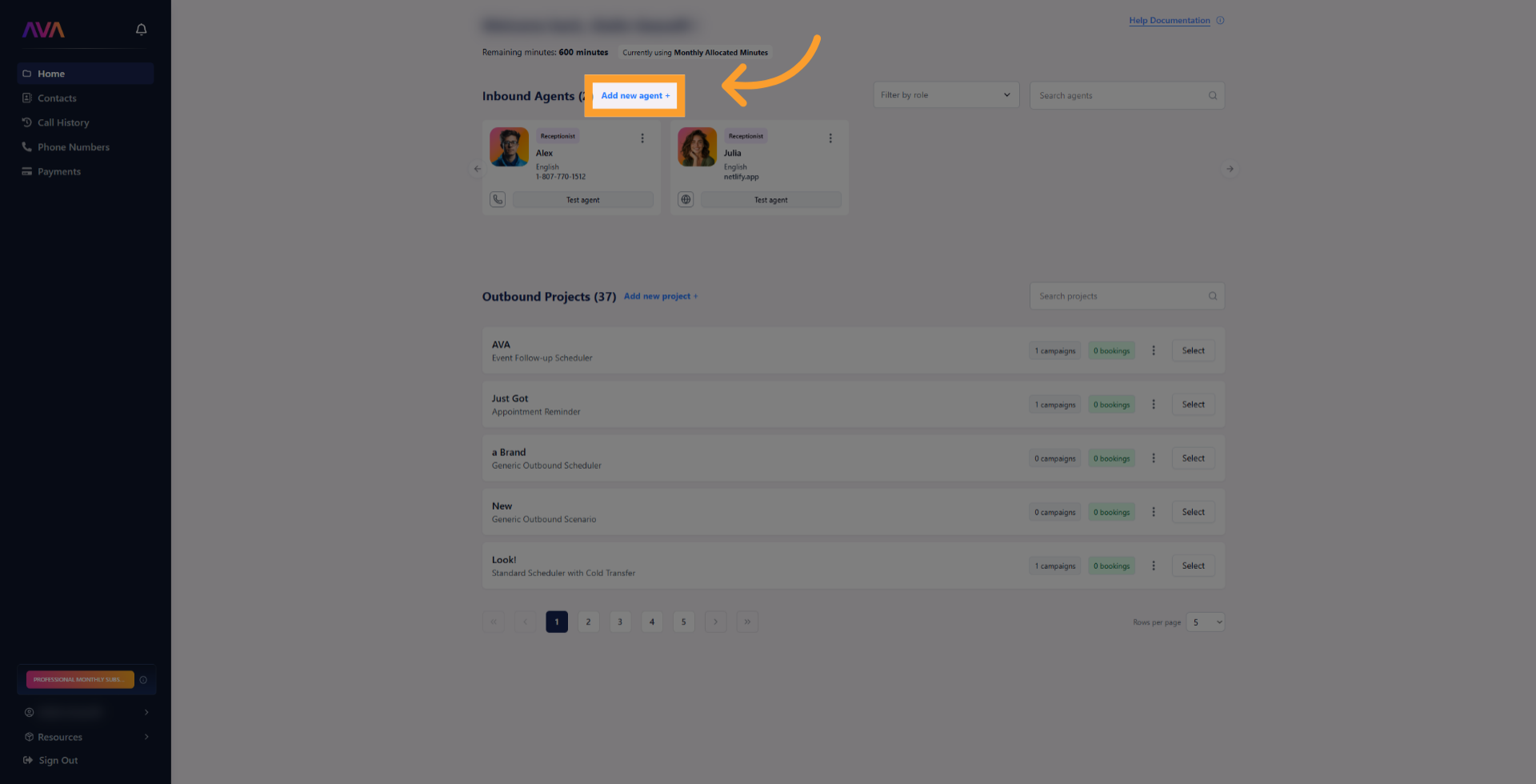
Otherwise, navigate to the Home screen in thinkrr and click “Add New Agent” in the Active Agents section in case you have already created an Inbound Agent or Outbound Project.
-
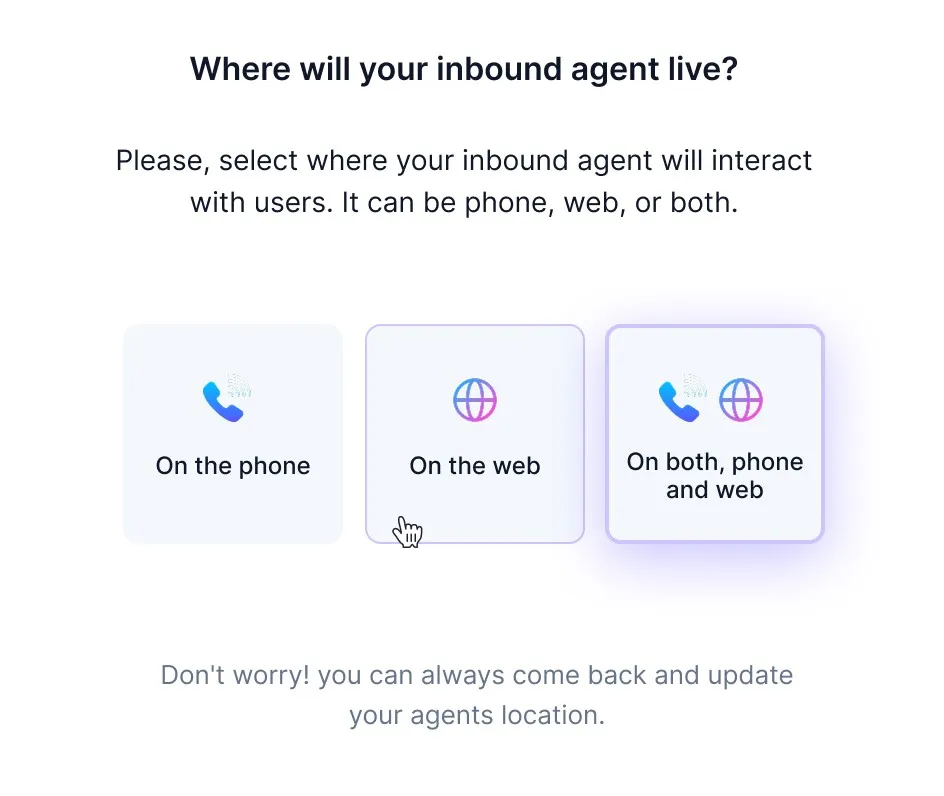
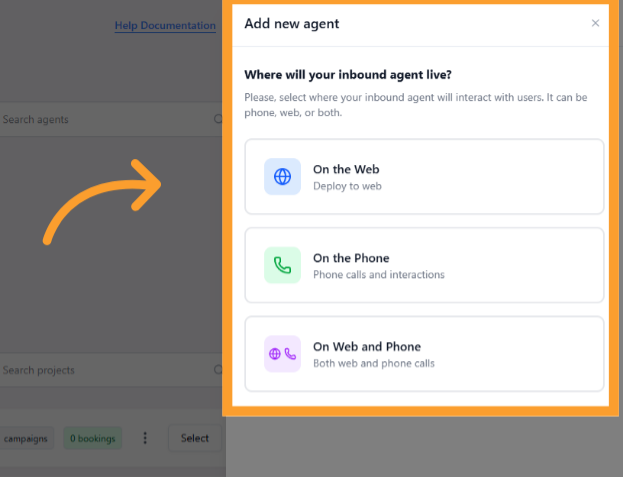
Choose whether the agent should be:
- Tied to a phone number
- Deployed to the web as a Web Widget (phone number not required)
-
Both over the phone and over the web
Configure Your Inbound Agent
When creating a new inbound agent, configuration is organized into three tabs: Agent Settings, Call Settings, and Voice Settings.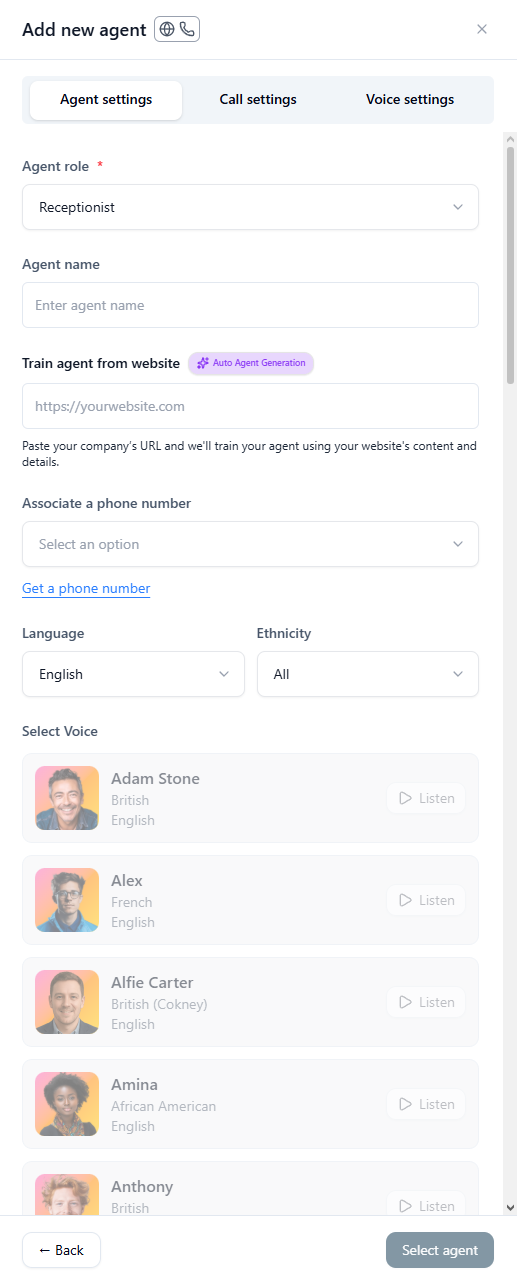
- Agent Settings
- Agent Role – Select a role like Receptionist to determine the agent’s function and tone.
- Agent Name – Customize how the agent refers to itself during calls. If left blank, it will use its default name.
- Train Agent from Website – Paste a public company URL and thinkrr will use your website content to pre-configure the training fields in the next step.
- Phone Number – Assign an available number (Inbound Agents cannot share phone numbers).
- Language – Agents can only speak their specifically assigned language. The selected language determines which voices are available.
- Ethnicity – Optional voice style filter to help narrow down accent and delivery options.
- Agent Voice – Use the Listen button to preview and select a voice.
-
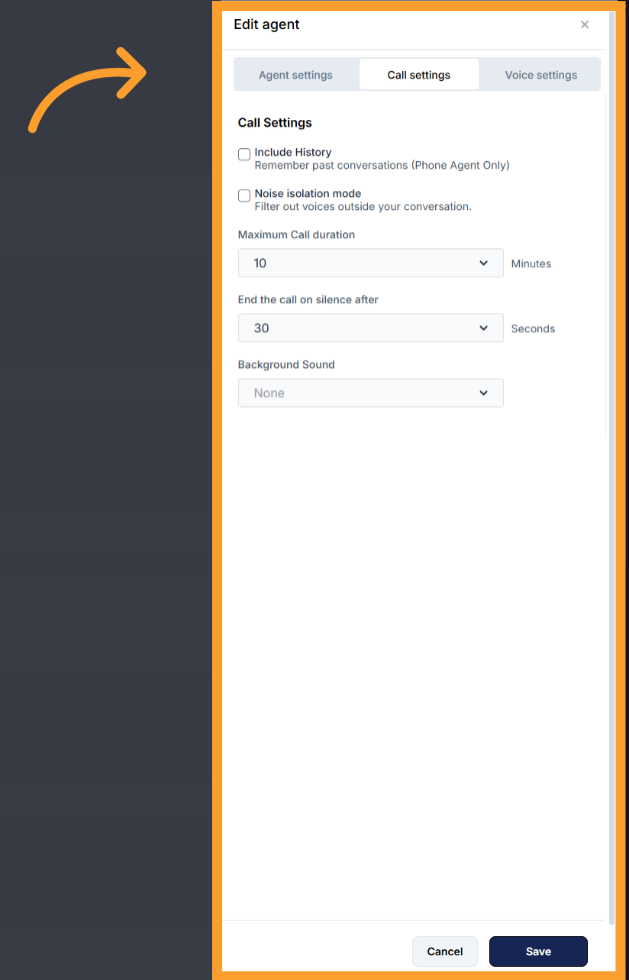
Call Settings
- Include History – Option to let the agent remember past conversations (phone agent only).
- Noise Isolation Mode – Filters out background voices.
- Maximum Call Duration – Caps call time (set in minutes).
- End Call After Silence – Ends calls automatically after a set period of silence.
- Background Sound – Add ambient noise (e.g., Coffee Shop).
- Background Volume Slider – Appears if background sound is enabled.
-
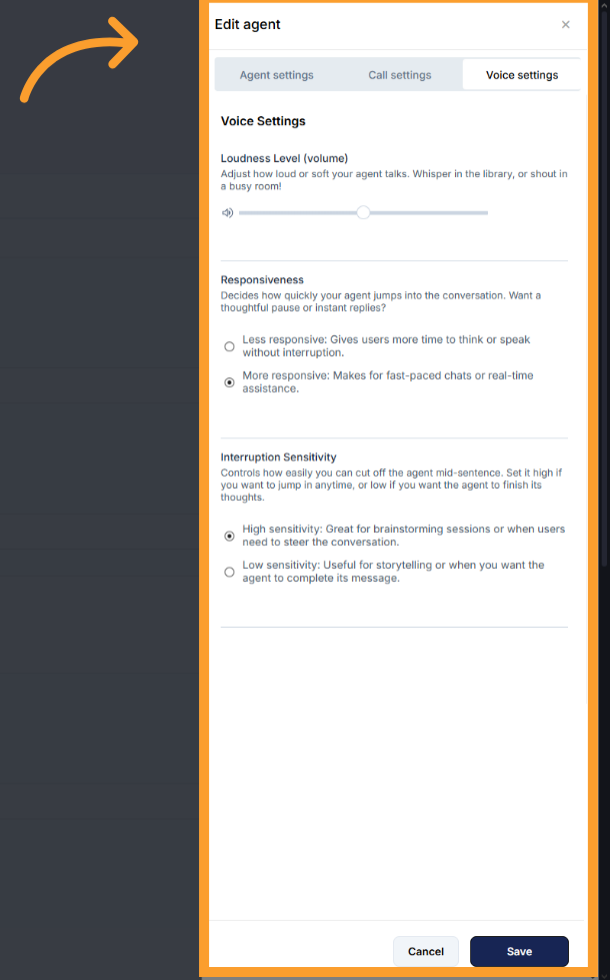
Voice Settings
- Loudness Level (volume) – Adjust how loud or soft your agent talks.
- Less responsive: Gives users more time to think or speak without interruption.
- More responsive: Makes for fast-paced chats or real-time assistance.
- Responsiveness – Decide how quickly your agent replies.
- Interruption Sensitivity – Controls how easily you can cut off the agent mid-sentence.
- High sensitivity: Easy to interrupt at any time.
- Low sensitivity: Agent will usually finish speaking before listening again.
- Loudness Level (volume) – Adjust how loud or soft your agent talks.
Select Minute Type
At the top of the Agent Configuration screen, you’ll see your total available minutes and current usage. From this section, click Manage to control which type of minutes this inbound agent will consume.You can choose from three options: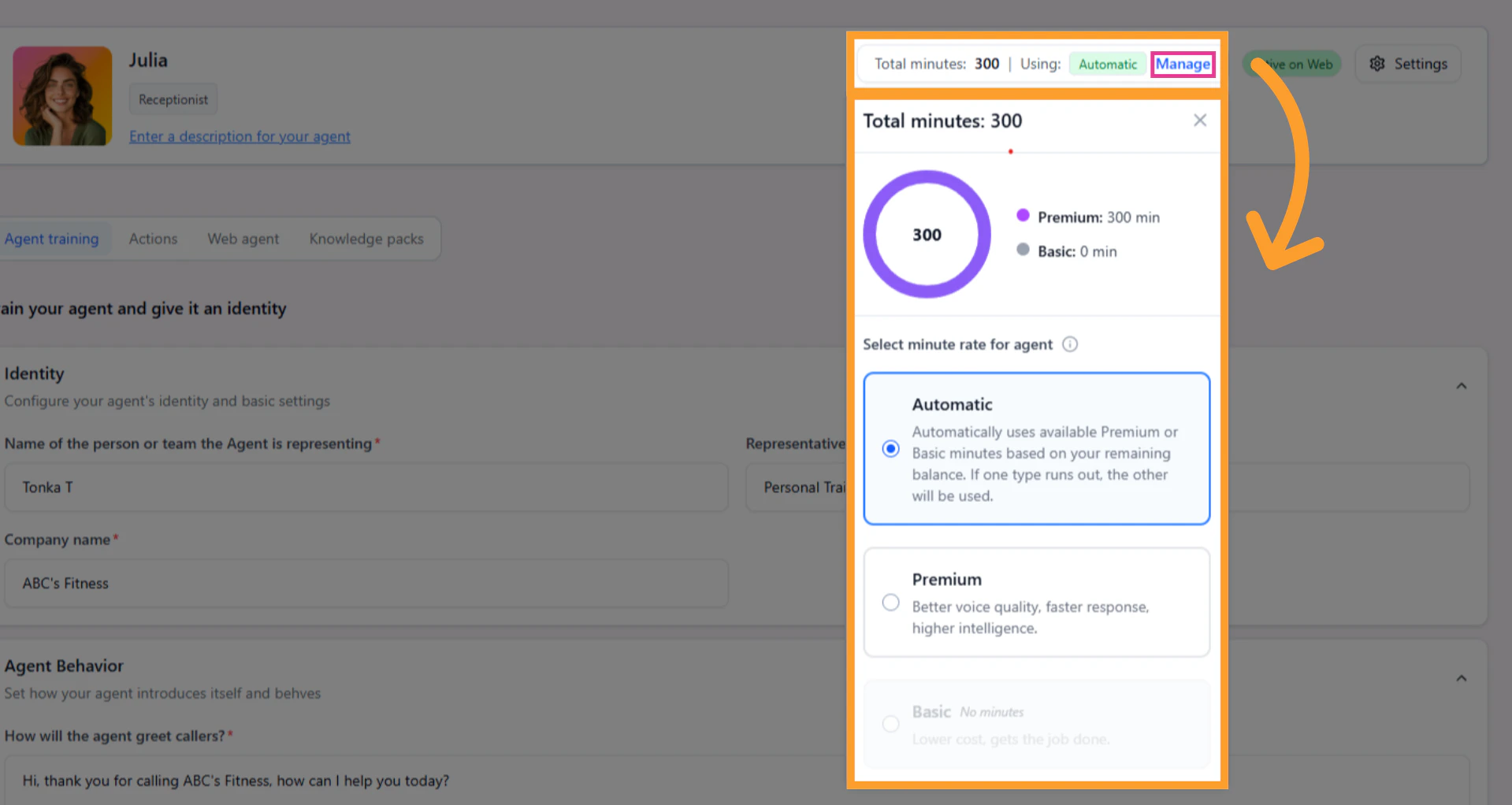
- Automatic – The system automatically selects which minutes to use based on priority.
- Premium – Only Premium minutes will be consumed.
- Basic – Only Basic minutes will be consumed.
Automatic Consumption Logic
When Automatic is selected, minutes are consumed in the following order:- Monthly Premium minutes
- Cheapest paid Premium minutes
- If Premium minutes were purchased in multiple bulk tiers, the lowest-priced tier is consumed first.
- Cheapest paid Basic minutes
Training the AI Agent
After you finish the initial setup tabs, you’ll land on the agent configuration screen. This screen is organized into four tabs: Agent training, Actions, Web agent, and Knowledge packs. You’ll configure them in that order, starting with Agent training.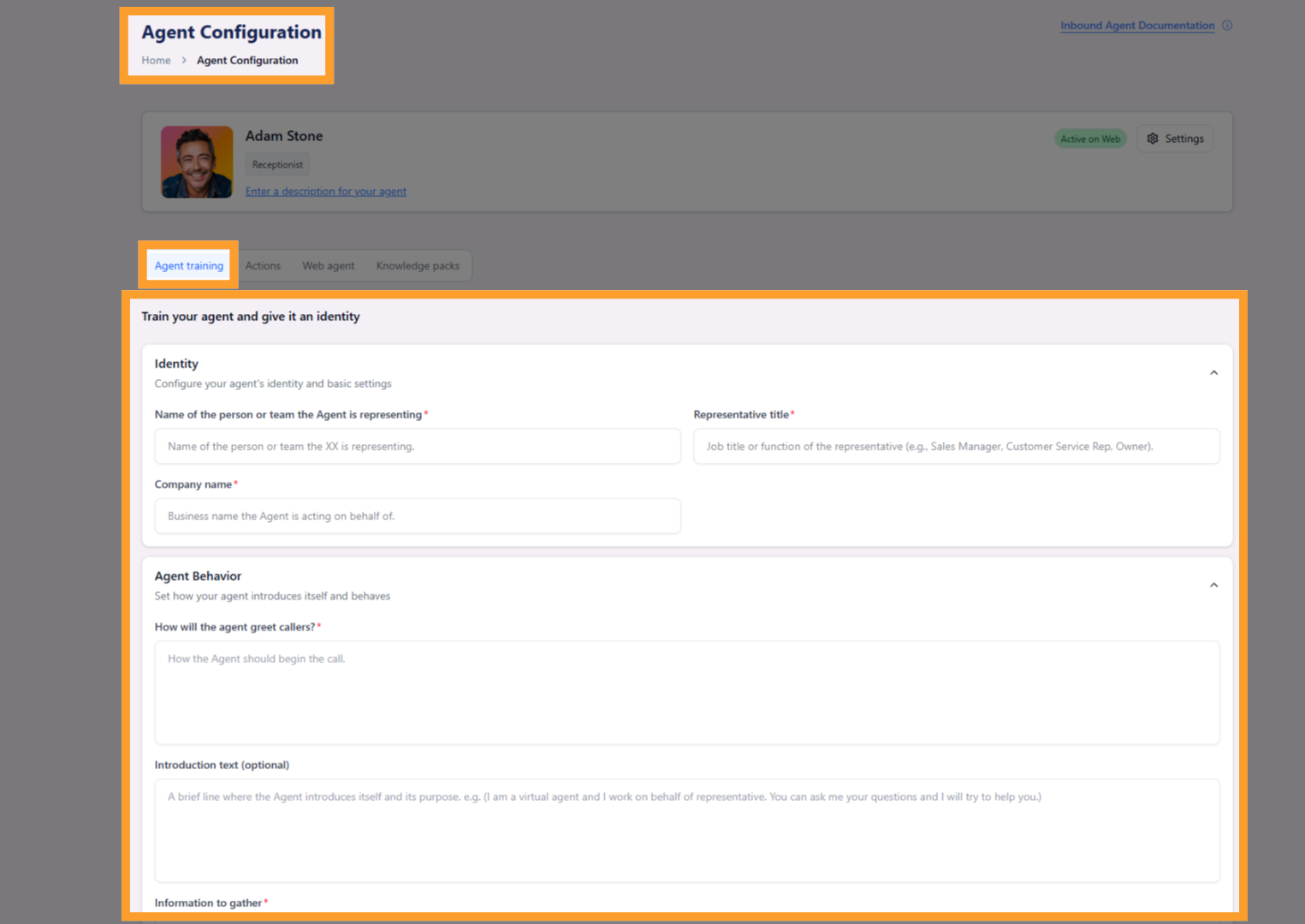
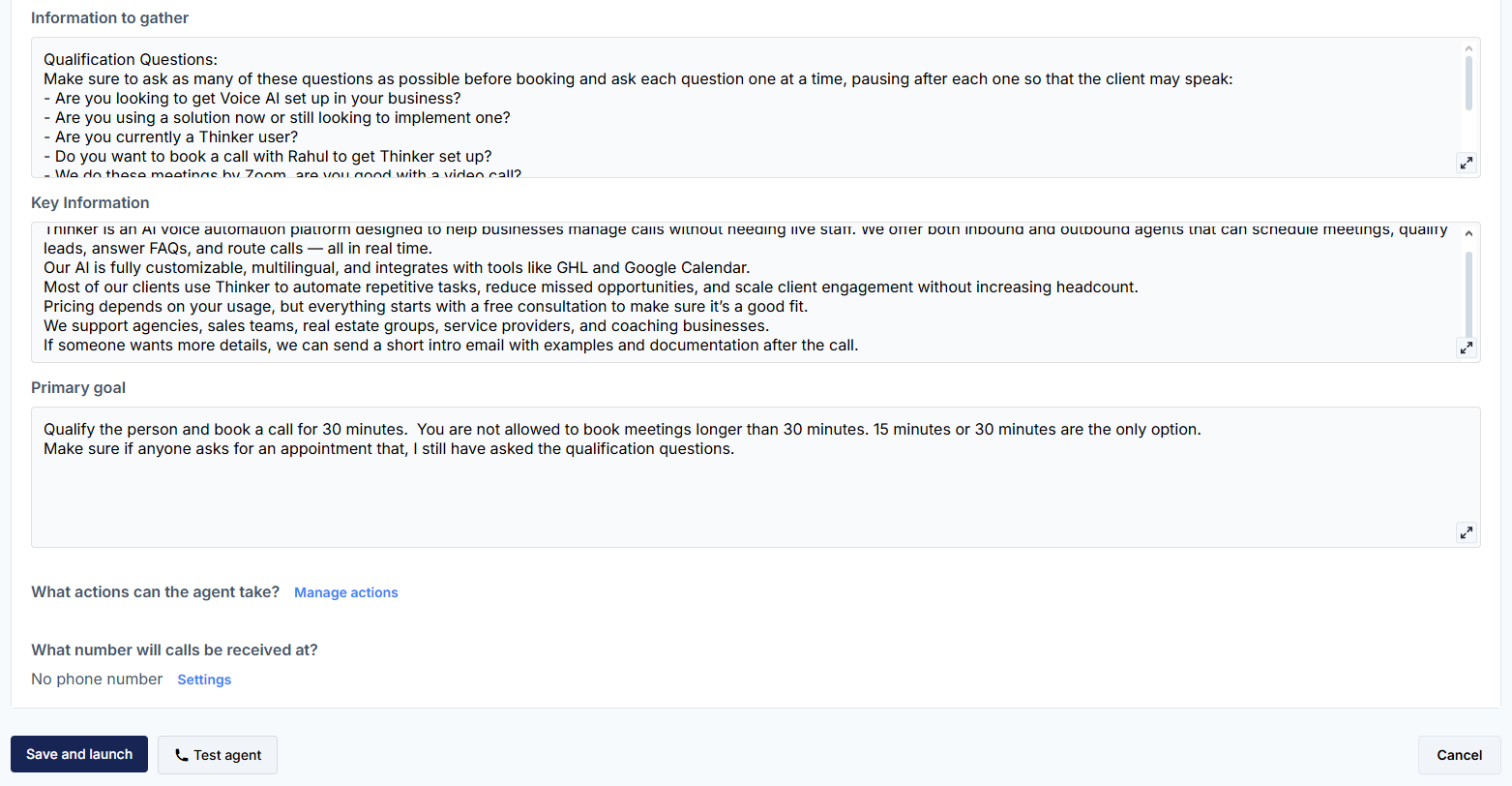
- Fill in all required training fields relevant to the selected Role.
- Each role—such as Receptionist or Sales Coach—has a unique set of training fields tailored to its purpose.
- Additional fields will dynamically appear based on the role.
- Greeting – What the Agent says when answering the call.
- Introduction text – Optional intro line to explain the Agent’s purpose.
- Representative name – Name of the person or team the Agent is assisting.
- Representative title – Job title (e.g., Sales Manager, Customer Support).
- Company name – The business or organization name.
- Information to gather – Details to collect from the caller.
- Key information – Internal info the Agent can reference (e.g., services offered).
- Primary goal – The Agent’s core task: answering questions, scheduling, etc.
Hint text and expanded field descriptions are now available directly in the UI to guide setup. Multiline fields also support rich text editing.
- Generate a structured starting configuration based on your goals.
- Refine or rewrite existing training fields.
- Adjust greetings, representative details, goals, and other role-based settings.
-
Click “AI-Copilot agent builder” Icon on the bottom-right side of the Agent Configuration interface to open the Copilot panel.
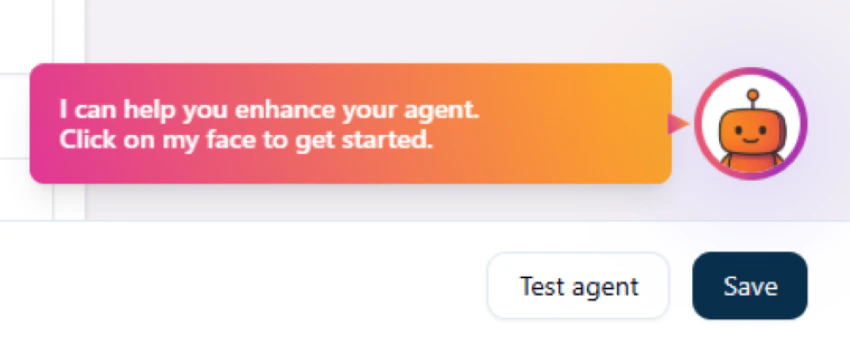
- Describe what you’d like to create or modify, then confirm the suggested updates.
- Copilot will automatically apply the approved changes to the relevant configuration fields.
Assign Actions to the Agent
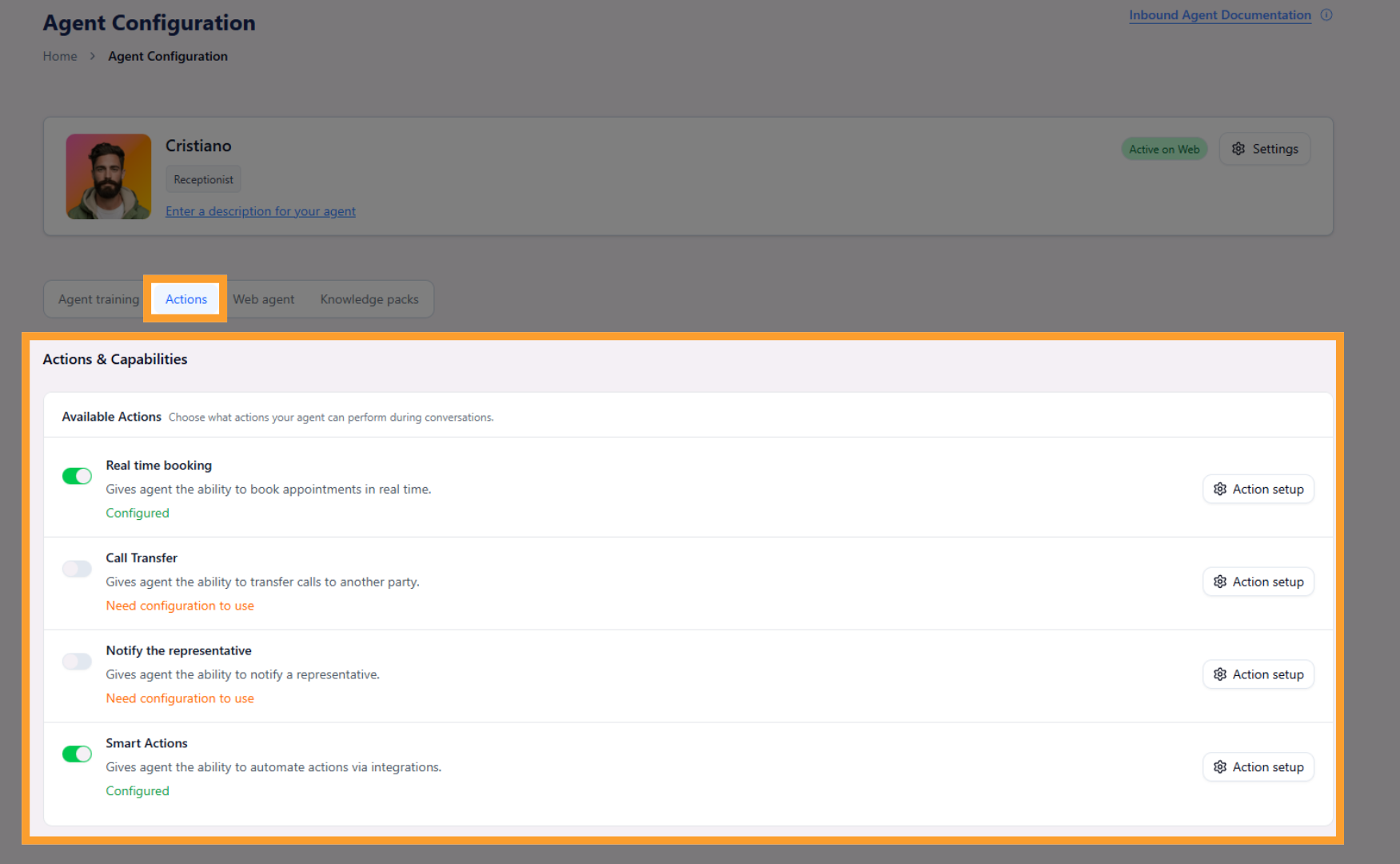
Next, go to the Actions tab to choose what actions your agent can perform during and after conversations.
- Here, you’ll see toggle switches for each available action:
- Turning a toggle on opens a side panel for configuration
- Once configured, the setup will be retained, even if later turned off
-
Re-enabling the toggle restores the saved configuration instantly
-
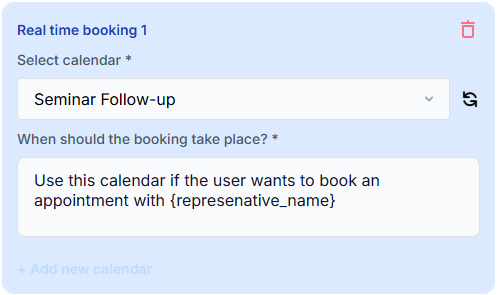
Real-Time Appointment Scheduling
- Allows the agent to book appointments using a connected calendar via GHL or thinkrr. Timezone alignment is required.
-
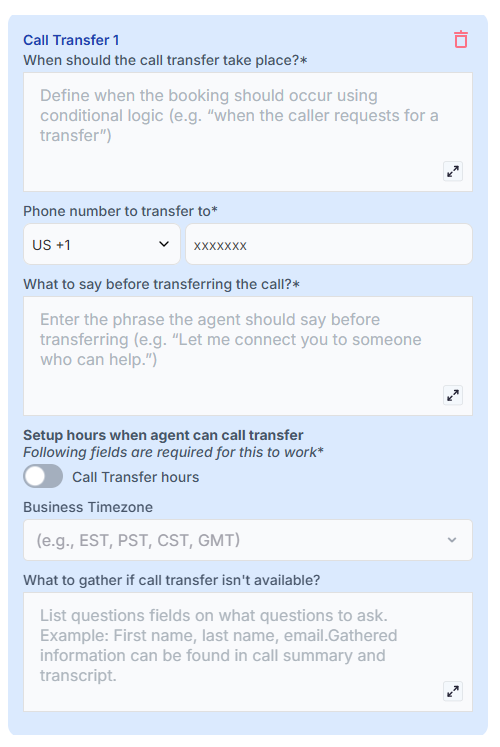
Call Transfer
- Enables the agent to transfer calls to another number or department.
- Multiple call transfers can be set up with unique hours and conditions. If two conditions are true at once, the system prioritizes the first configuration in the list.
- You can configure business/availability hours for inbound call transfers to avoid disruptive off-hour transfers (e.g., 3 AM calls).
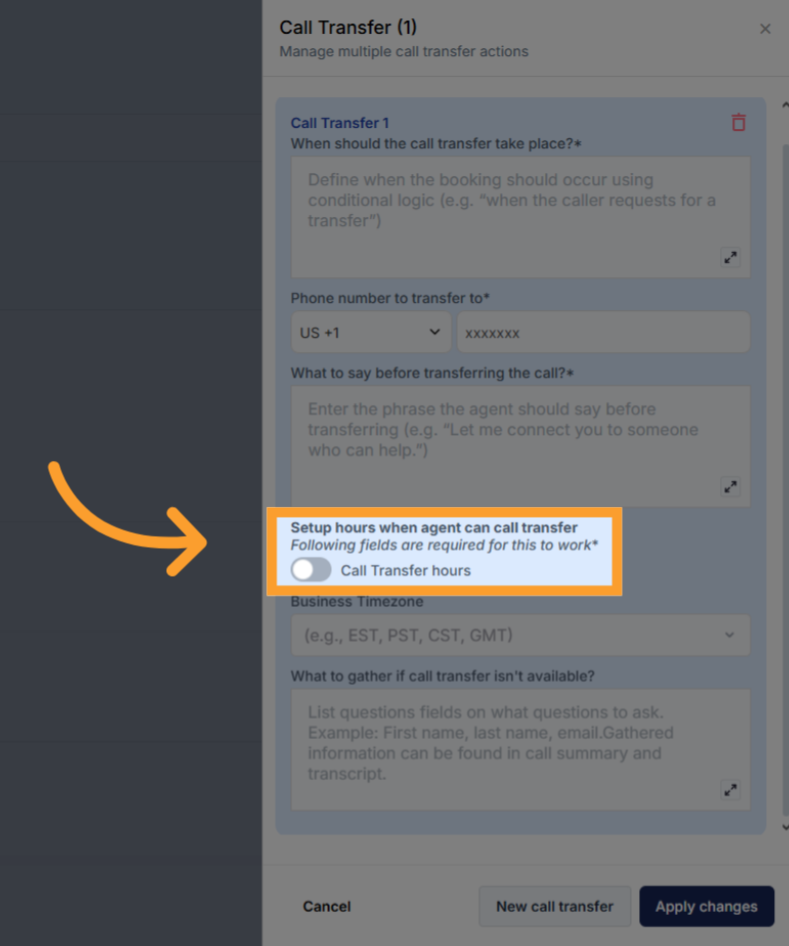
- Select your timezone and select the days of the week and customize the hours for each day. After customizing one day, use Copy All to apply the same hours across all days, if you wish.
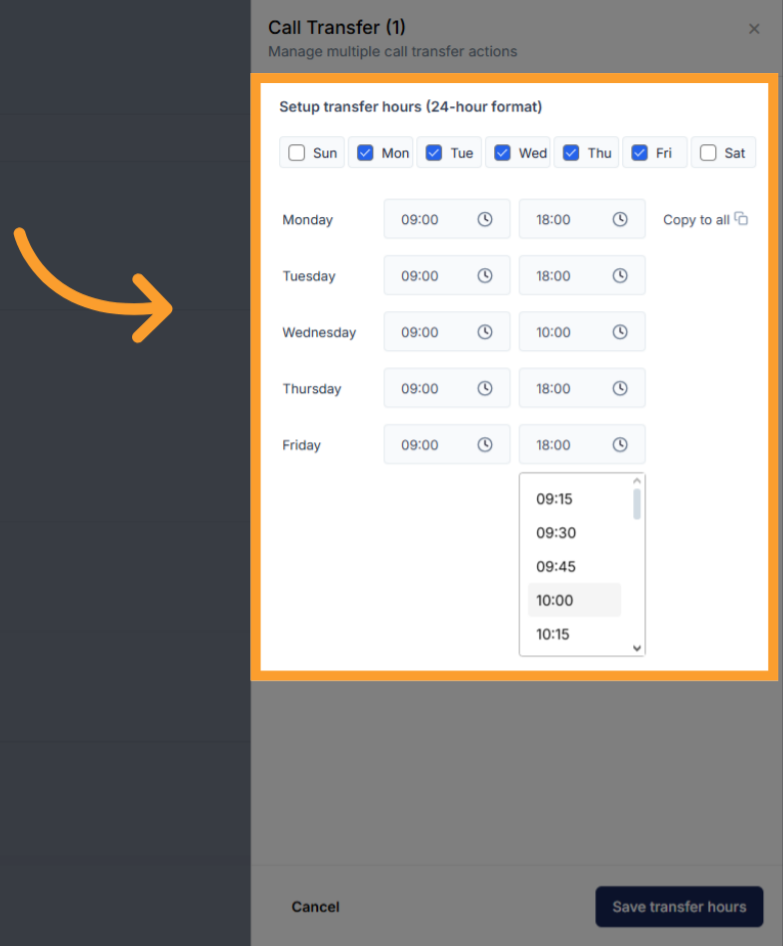
- Outside configured hours, the agent will offer alternatives such as taking a message or sending an email.
-
Notify the Representative
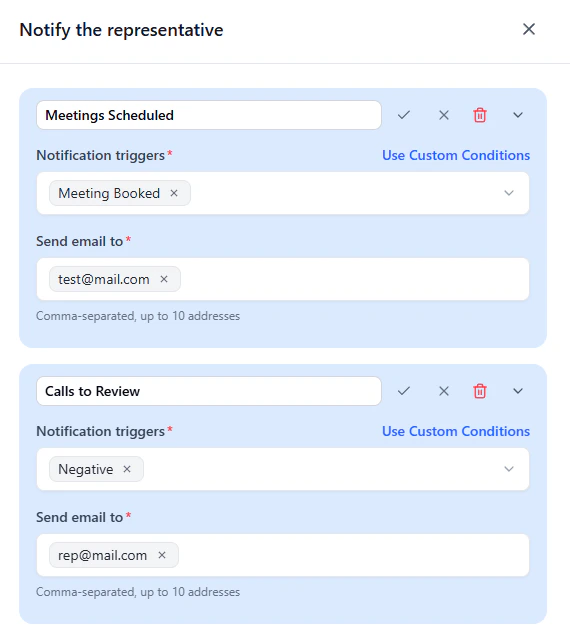
- Sends email notifications to the designated representative based on the conditions you choose.
- You can configure multiple different notifications for all calls or narrow them down using filters.
- Notifications can be triggered based on:
- Call Status
- Call Outcome
- Call Sentiment
- You can also use custom conditions to trigger notifications based on what the caller said or how the call was handled.
- This helps reduce unnecessary emails and makes it easier to notify the right people only when specific call results need attention.
-
Smart Actions
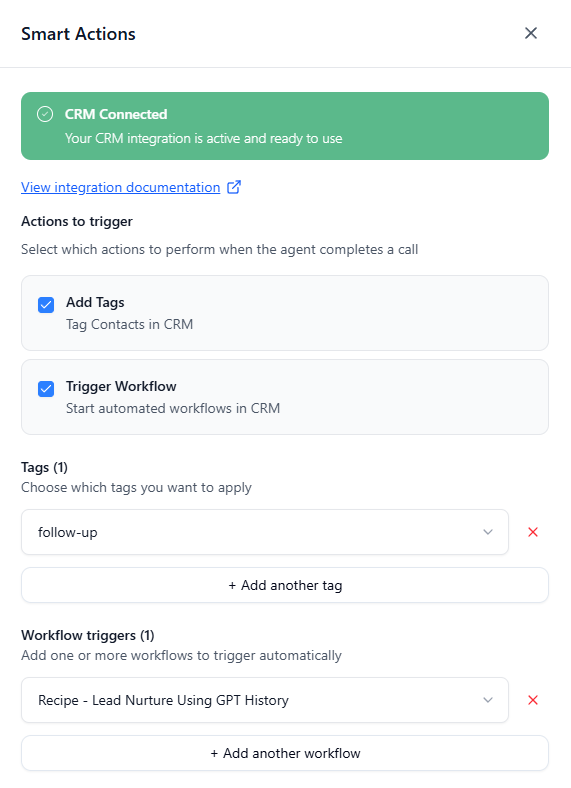
- Allows your agent to automate CRM follow-up actions after completing a call.
- Smart Actions require an active GoHighLevel CRM connection before they can be enabled.
- Once turned on, you can choose which actions should run when the agent finishes a conversation.
-
Actions to trigger: Check the boxes according to which actions you want automated
- Add Tags
- Automatically apply one or more CRM tags to any contact who interacts with this inbound agent.
- Tags must already exist inside GoHighLevel before they can be selected.
- Trigger Workflow
- Automatically start one or more published GoHighLevel workflows after the call ends.
- Workflows must be configured and published inside GoHighLevel before they appear in the selection list.
- Add Tags
-
After selecting your actions, you can configure:
- Tags
- Choose which tags should be applied whenever a contact calls this agent.
- Add multiple tags if you want the agent to assign follow-up or lead status labels automatically.
- Workflow Triggers
- Select one or more published workflows to trigger automatically after each completed call.
- This is useful for launching nurture sequences, internal notifications, or CRM-based follow-up automation without manual workflow triggers.
- Tags
⚠️ Important If you trigger workflows using Smart Actions, do not use Inbound Agent Call or AI Voice Studio Smart Trigger as the workflow trigger in GoHighLevel. Otherwise, the workflow may run twice.
Smart Actions are ideal for automatically tagging inbound leads and launching CRM workflows immediately after an agent interaction. -
Send Reports
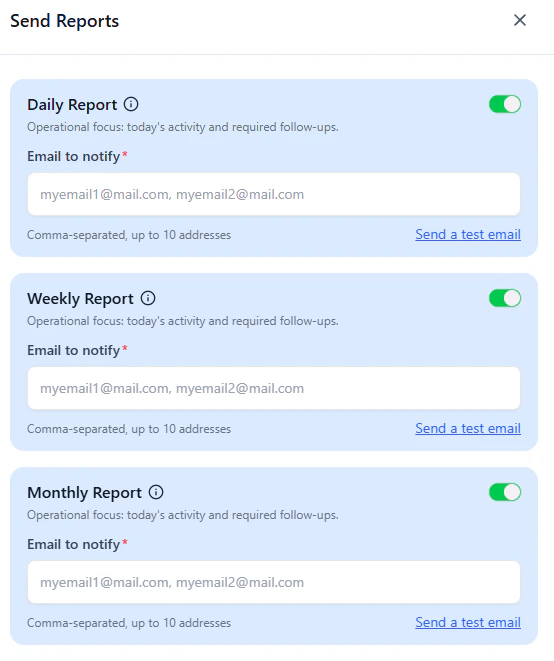
- Sends report emails summarizing the calls handled by that agent.
- You can configure:
- Daily reports
- Weekly reports
- Monthly reports
- You can add up to 10 email recipients for each report setup.
- Reports are sent automatically and provide a broader view of that agent’s call activity and performance.
-
Action states may show:
- Need configuration to use
- Configured
- Disabled
-
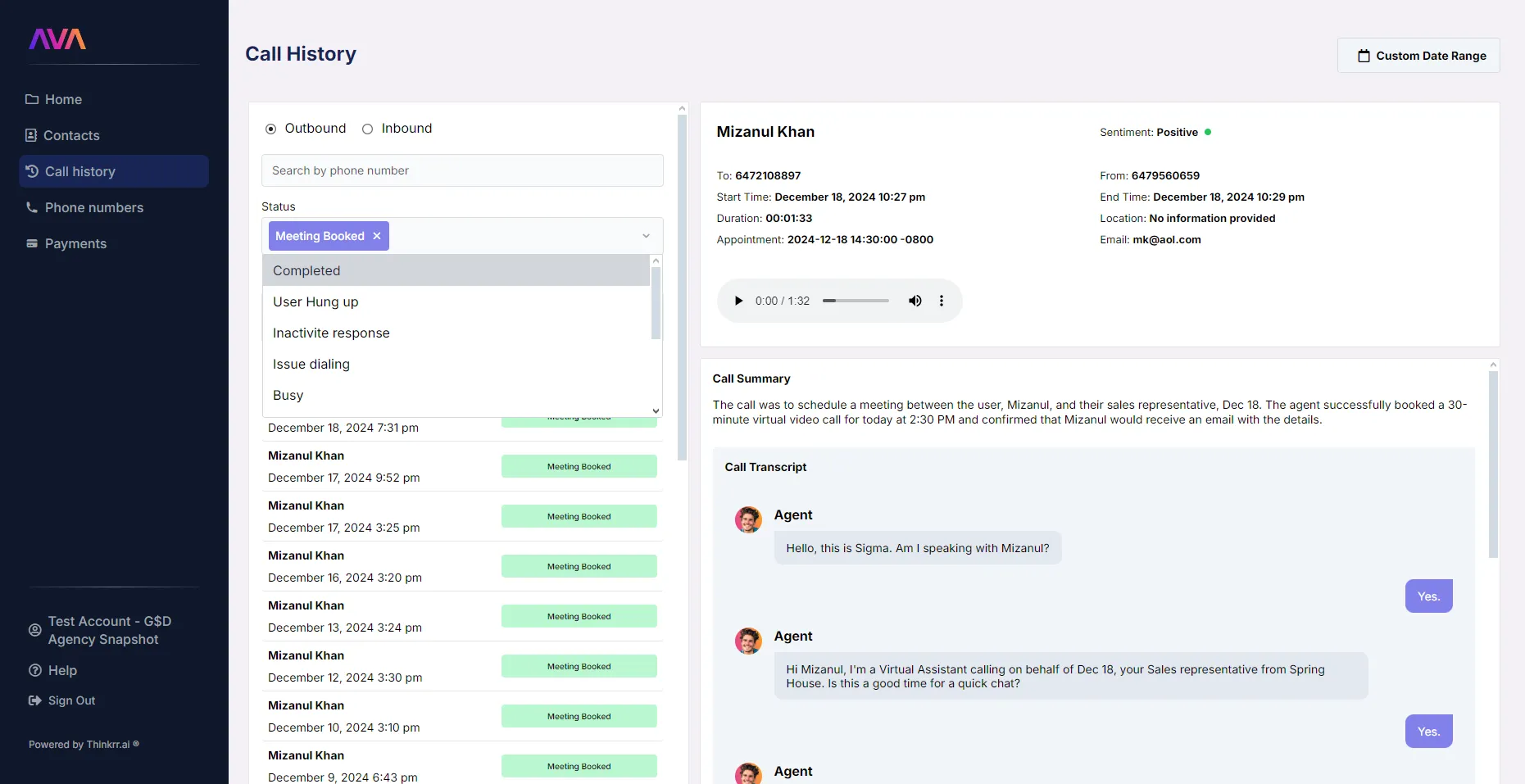
You can also review and manage all past conversations using the Call History tab:
Optional: Configure the Web Widget
If your Receptionist Agent is also or only deployed to the web, you can customize its appearance and placement using the Web agent tab.
Configure the Web Widget
Configure the Web Widget
If your Receptionist Agent is also or only deployed to the web, you can customize its appearance, behavior, and placement using the Web Agent tab.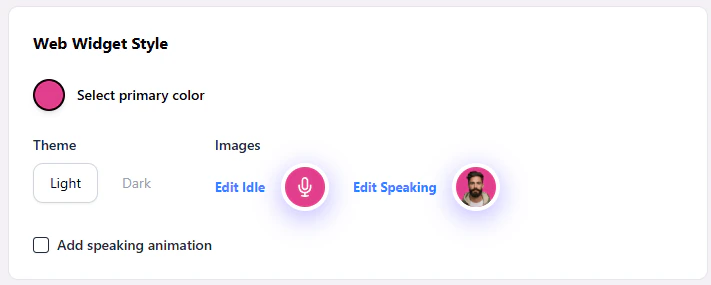
Web Widget Style
- Theme Selection – Choose between:
- Light
- Dark
- Edit Idle – Select the visual displayed when the widget is idle.
- Edit Speaking – Select the visual displayed while the agent is speaking.
- You can:
- Choose from available agent faces
- Select from built-in icons
- Upload a custom image (PNG format - 64 by 64 pixels recommended) for either Idle or Speaking state
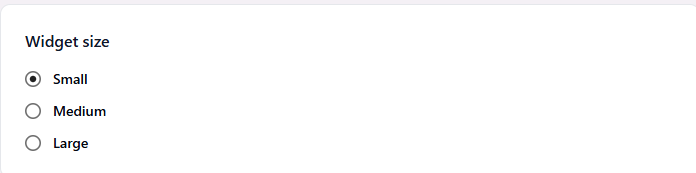
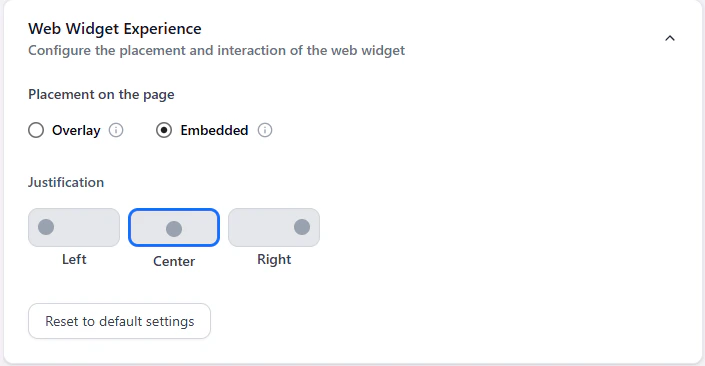
Web Widget Experience
-
Placement Type
- Overlay – Displays on top of your website content.
- Embedded – Integrated directly into your page layout.
-
Justification
- Left
- Center
- Right
-
You can reset the configuration at any time using Reset to default settings.
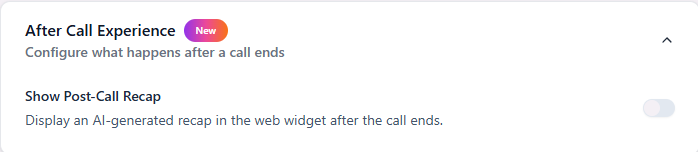
After Call Experience
- Toggle this setting to display an AI-generated recap in the web widget after a conversation ends.
-
When enabled, users will see a short summary of what was discussed once the call is completed.
Optional: Add a Knowledge Pack
If you want your agent to reference business documentation during conversations, go to the Knowledge packs tab and add a Knowledge Pack.
Add a Knowledge Pack
Add a Knowledge Pack
A Knowledge Pack allows your agent to access and reference structured company information during conversations. It can be used across both inbound and outbound projects.Depending on your plan, you can create one or more Knowledge Packs and attach them to specific agents as needed.Supported plans:
- Business Professional: 1 Pack
- Business Growth: 2 Packs
- Agency Lite: 1 Pack
- Agency Unlimited: 2 Packs
Steps to Add a Knowledge Pack:
-
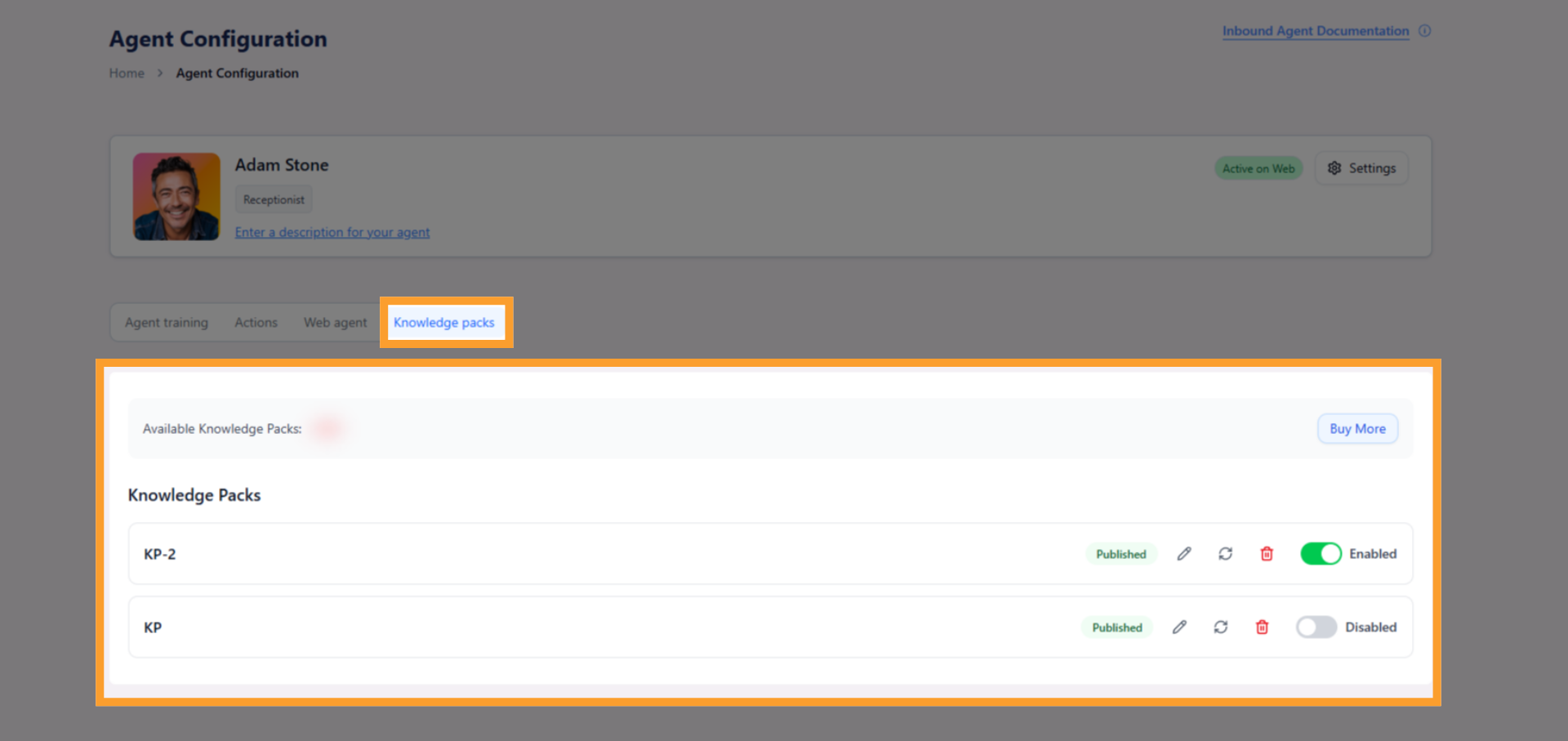
In your inbound agent configuration screen, scroll down and click “Knowledge Packs.”
-
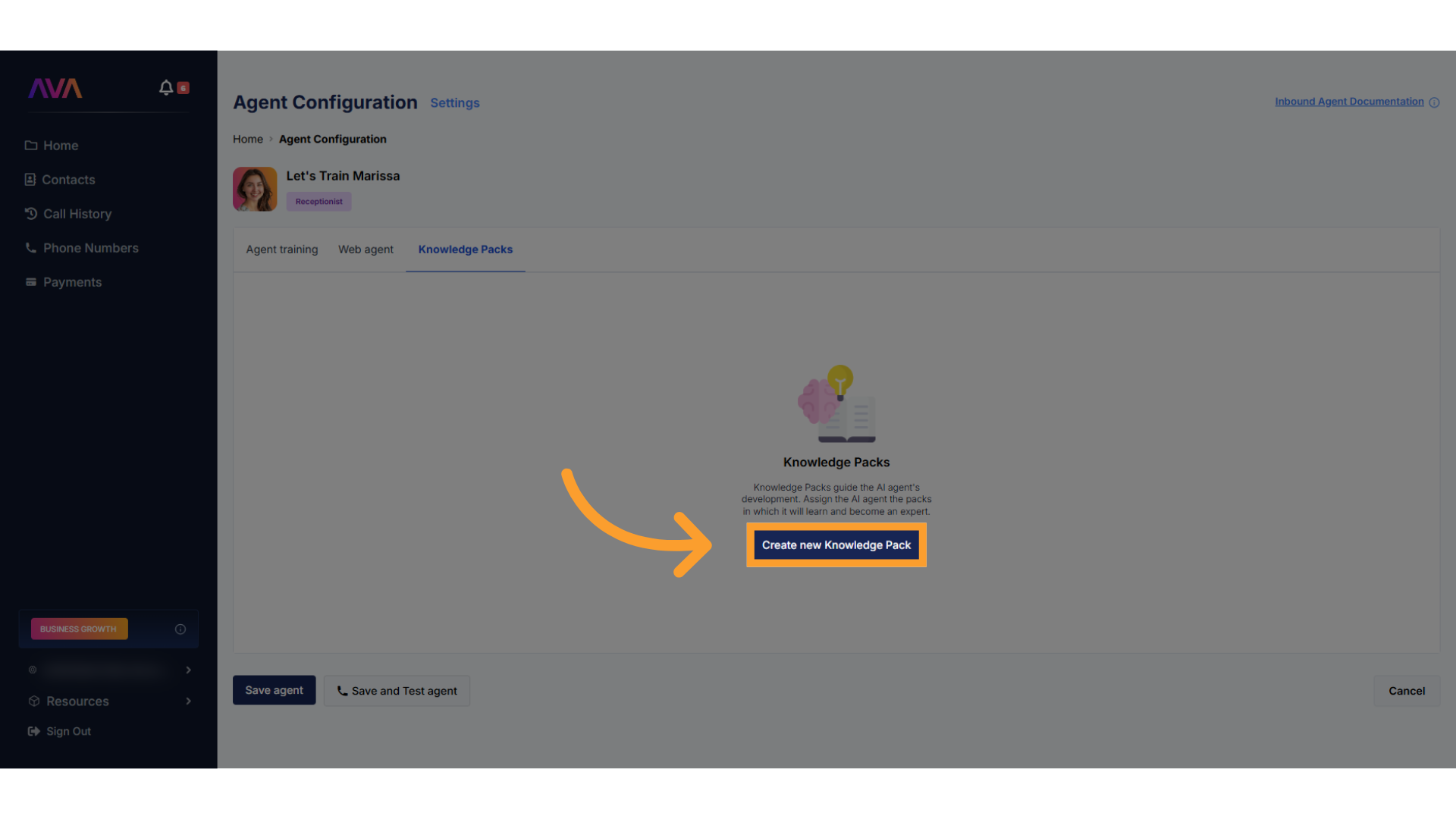
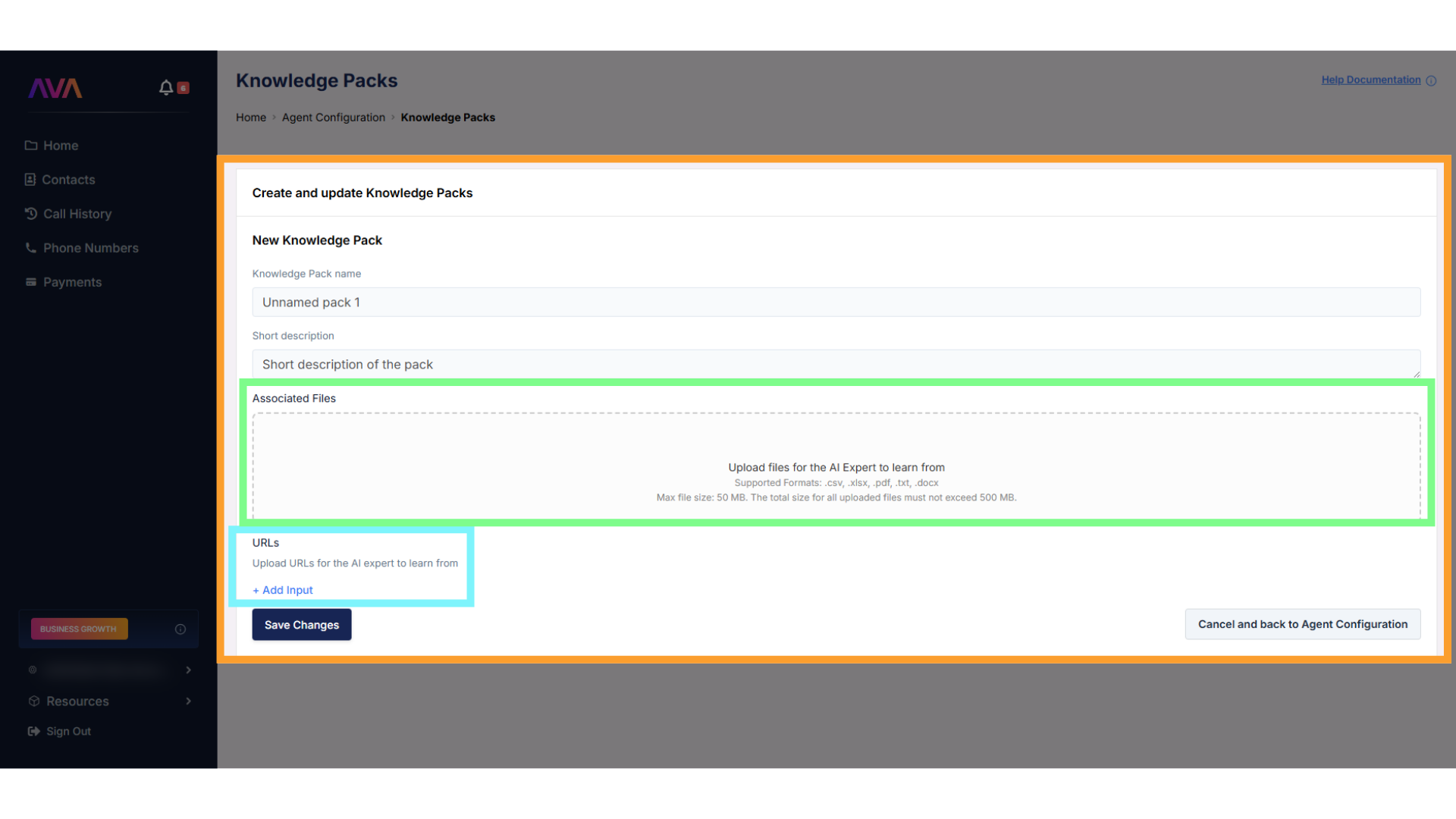
Click “Create New Knowledge Pack” to launch the builder.
-
Choose one or both of the following sources:
- Upload files in
.csv,.xlsx,.pdf,.txt, or.docxformat- Up to 50MB per file; total upload limit of 500MB, maximum of 25 files.
- Enter URLs to let thinkrr scan web pages for reference content
- Upload files in
-
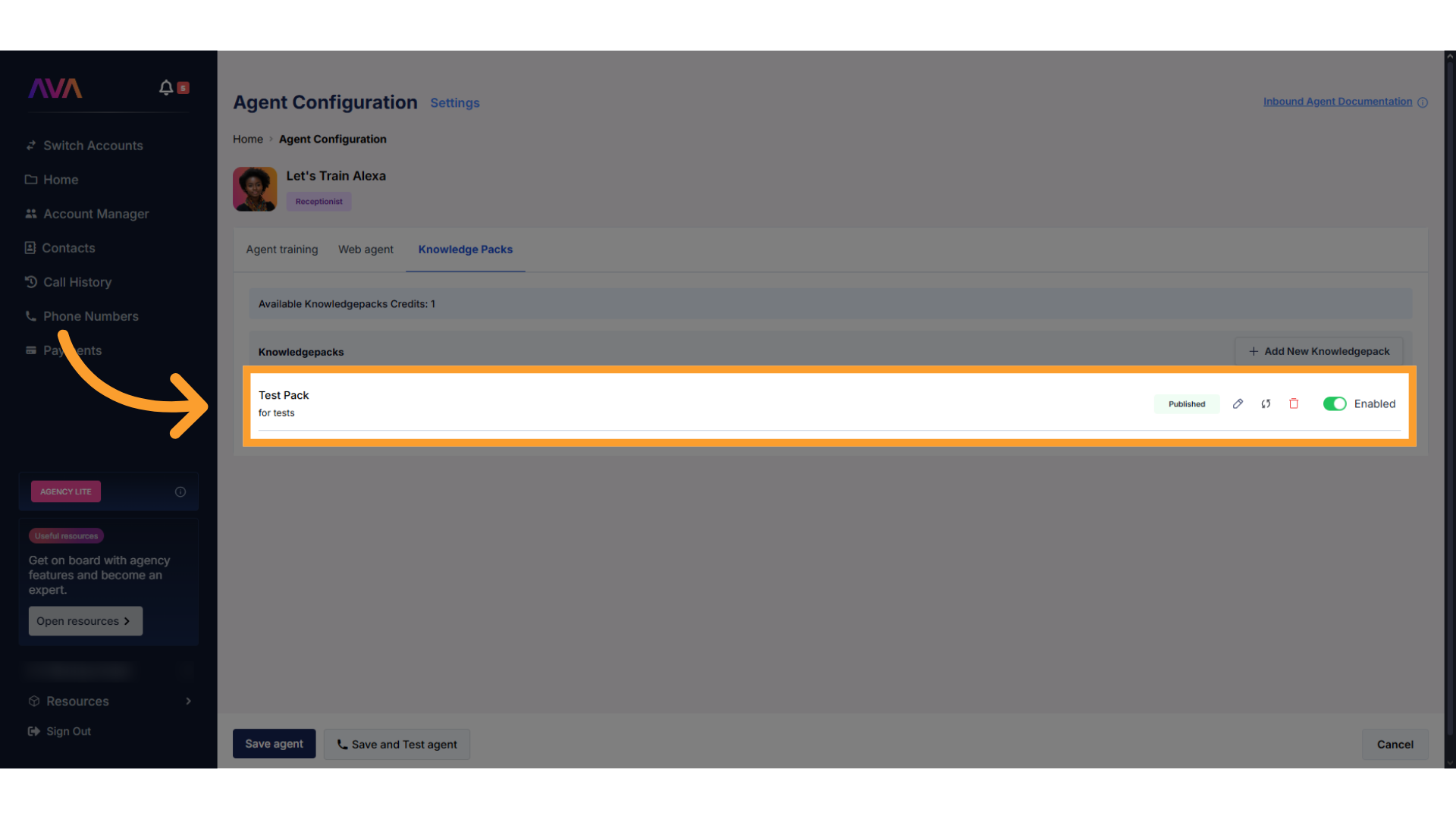
Once created, you can edit, delete, or refresh your pack from the right-hand menu.
- To disable access temporarily, simply turn off the pack instead of deleting it.
-
You can re-enable the same pack at any time without losing the content.
Configure Settings
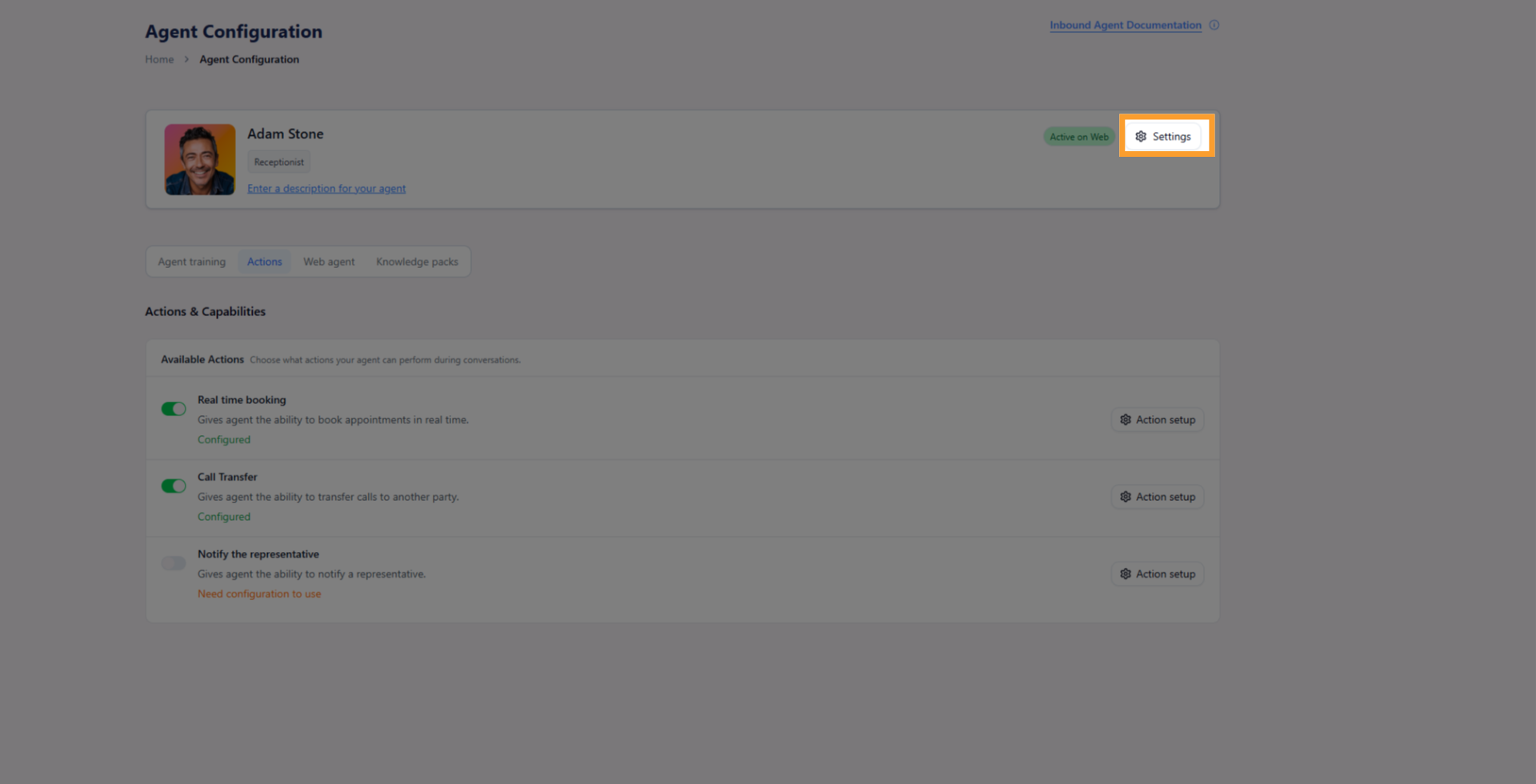
- After training and assigning actions, you can return to adjust settings at any time.
- Click the Settings button at the top left of your agent’s page. This reopens the same three tabs—Agent Settings, Call Settings, and Voice Settings—allowing you to revisit or update any configuration made during setup.
.gif?s=8febf82937e8de13774c40336d00ed1b)
FAQs & Troubleshooting
General Questions
Can I create multiple Inbound Agents?
Can I create multiple Inbound Agents?
Yes, you can create multiple Inbound Agents for different tasks.
Can I assign the same phone number to two inbound agents?
Can I assign the same phone number to two inbound agents?
No, each Inbound Agent must have a unique phone number. However, the same number can be used for outbound campaigns.
Can an inbound agent be used for web chat?
Can an inbound agent be used for web chat?
Yes, an Inbound Agent can function both as a phone receptionist and a web-based assistant.
Can inbound agents handle multiple calls at the same time?
Can inbound agents handle multiple calls at the same time?
Yes, inbound agents are designed to handle multiple concurrent calls without any issue.
Do I need to train the agent from my website during creation?
Do I need to train the agent from my website during creation?
No. If you don’t paste a URL during agent creation, you can add one later at any time. Open the agent configuration screen, click Settings at the top, and paste your website URL there to retrain and overwrite the existing training fields.
What is the difference between Notify the Representative and Send Reports?
What is the difference between Notify the Representative and Send Reports?
Notify the Representative is used for event-based email notifications, so you can alert someone when a call matches specific conditions such as a particular status, outcome, sentiment, or custom prompt-based condition. Send Reports is used for daily, weekly, or monthly summary emails that give you a broader overview of that agent’s calls.
Troubleshooting Questions
My Inbound Agent isn’t picking up calls.
My Inbound Agent isn’t picking up calls.
- Ensure the assigned phone number is correct.
- Ensure you have minutes added to the account the agent is set up
My web Agent isn’t appearing on my website.
My web Agent isn’t appearing on my website.
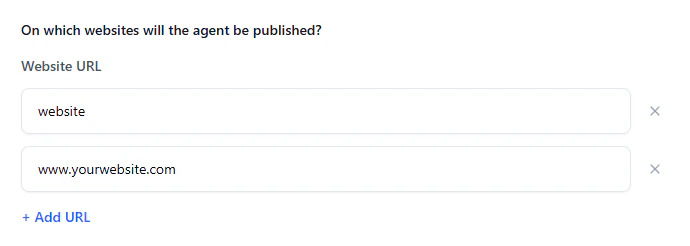
- Confirm that the correct domain is entered in the Web Agent settings.
- Ensure that the code snippet is embedded correctly in the website.
My test call isn’t working.
My test call isn’t working.
- Allow microphone and speaker permissions in your browser.
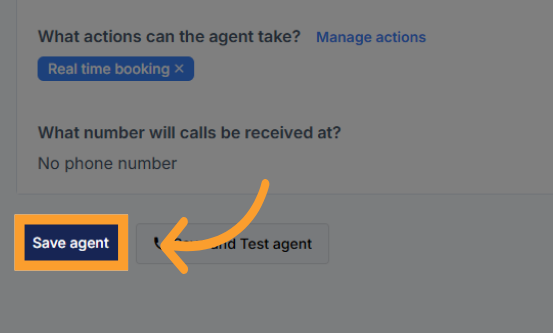
- Make sure the Inbound Agent is saved before testing.
For additional questions or guidance, try using our Virtual Support Agent! Available 24/7 to help resolve most issues quickly at thinkrr.ai/support. If you still need assistance, visit our support site at help.thinkrr.ai and submit a Ticket or contact our team directly at hello@thinkrr.ai.